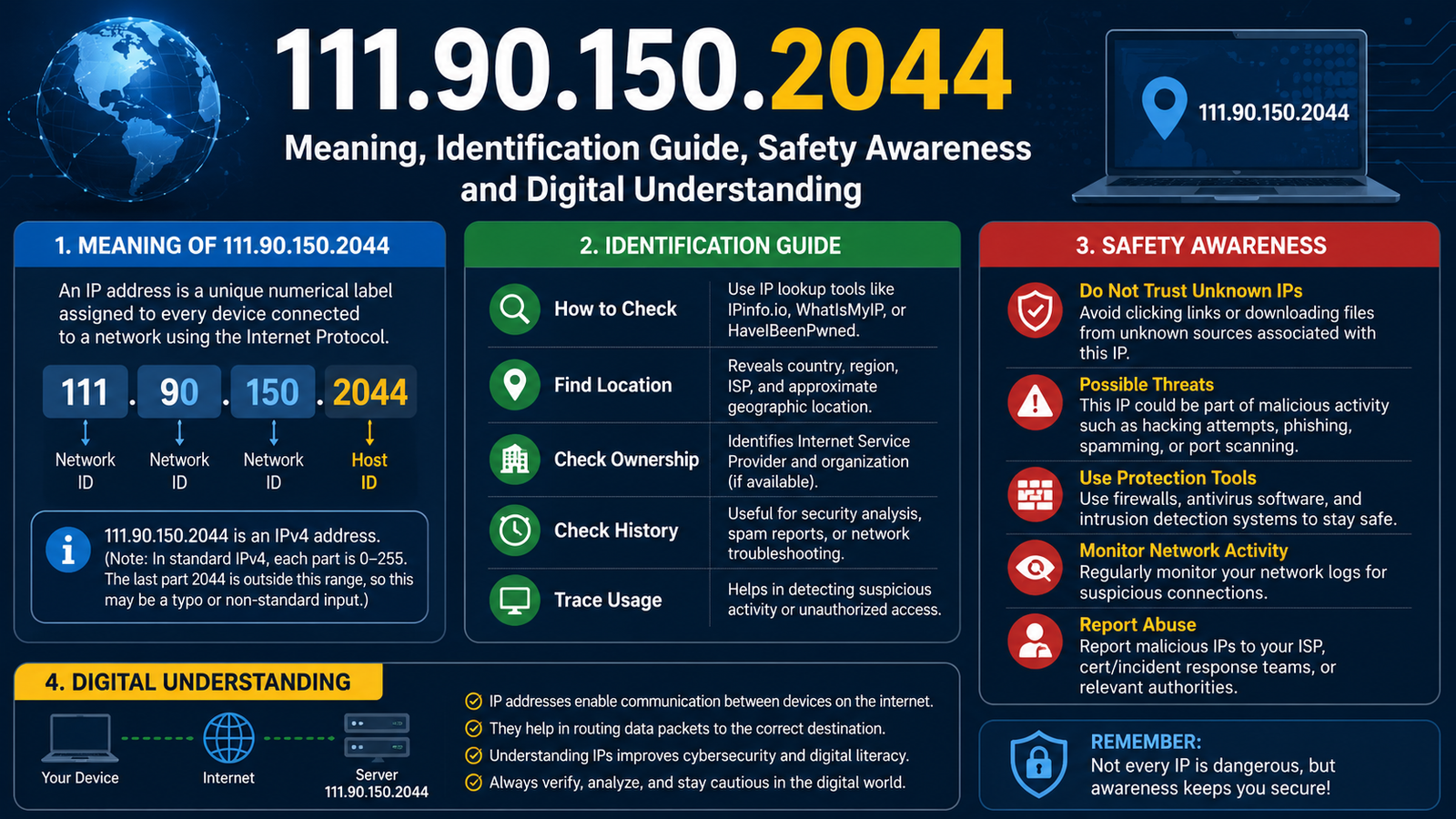
The string “111.90.150.2044” appears like a technical numeric identifier that users may encounter in logs, analytics tools, server records, or sometimes as part of suspicious messages. Unlike standard phone numbers, this format does not clearly match a typical mobile or landline structure, which makes users search it for clarity. In many cases, such numeric patterns are related to IP addresses, tracking systems, or internal server data. This article explains what 111.90.150.2044 could represent, why it may appear in digital environments, how to analyze it safely, and what precautions you should take when encountering unfamiliar technical identifiers.
Understanding 111.90.150.2044
Possible Nature of the String
The value 111.90.150.2044 looks similar to an IP address, but it is technically not a valid IPv4 format because standard IPv4 addresses only allow values from 0 to 255 in each segment. The last segment “2044” exceeds this range.
So it may represent:
- A malformed or incorrect IP address
- A logging or system error entry
- A tracking or session identifier
- A modified internal database reference
- A corrupted or concatenated data string
Because of this, it should not be treated as a normal network address.
Why People Search This Type of Number
Users often search strings like this because they appear in:
- Website server logs
- Security or firewall alerts
- Analytics dashboards
- Email headers or metadata
- Suspicious messages or technical errors
People try to understand whether it is linked to hacking, tracking, or system activity.
Real-World Scenarios Linked to 111.90.150.2044
Server or Log Entry Errors
One common reason for seeing this type of string is:
- Incorrect logging configuration
- Data corruption in analytics systems
- Exported logs combining multiple values
- Formatting issues in backend systems
This can create invalid IP-like strings.
Tracking or Internal System Data
Some platforms generate identifiers that resemble IP structures but are not actual IPs. These may be used for:
- Session tracking
- Device grouping
- Internal routing identifiers
- Debugging or analytics tags
In such cases, it is not related to public internet users.
Security or Misinterpreted Data
Sometimes users assume such strings are:
- Hacker IP addresses
- Cyberattack sources
- Suspicious network activity
But in many cases, it is simply a formatting or system-generated artifact, not an actual threat.
How to Safely Analyze 111.90.150.2044
Step 1: Verify the Format
Check if it is a valid IP address:
- IPv4 format = four numbers separated by dots
- Each segment must be between 0 and 255
Since “2044” exceeds the limit, this is not a valid IP.
Step 2: Identify Where It Appeared
Look at the source:
- Website logs
- Email headers
- Software dashboard
- Error message
- Security tool output
Context is critical to interpretation.
Step 3: Check System Logs or Admin Tools
If you are a website or system user:
- Check server configuration
- Review logging format
- Inspect analytics parsing rules
This helps identify whether it is a formatting issue.
Step 4: Avoid Assuming Security Threats
Do not immediately assume:
- It is a hacker IP
- It is a cyberattack source
- It is malicious traffic
Most cases are technical errors, not threats.
Digital Safety Perspective
When It Could Be Harmless
This type of string is usually harmless when:
- Found in internal logs
- Generated by software systems
- Appearing in analytics reports
- Caused by formatting errors
When to Be Cautious
You should investigate further if:
- It appears in security alerts repeatedly
- It is linked with unauthorized access attempts
- It appears in firewall blocking reports
Even then, validation is required before conclusions.
Good Security Practices
- Keep logging systems properly configured
- Validate IP parsing rules
- Monitor firewall alerts properly
- Avoid misinterpreting raw data as attacks
Why Strings Like 111.90.150.2044 Appear Online
There are several reasons:
- Misconfigured server logs
- Exported analytics data errors
- Software debugging outputs
- Data merging issues
- Copy-paste corruption from databases
These are common in technical environments.
Should You Be Concerned About 111.90.150.2044?
The string 111.90.150.2044 is not a valid IP address, so it is not automatically dangerous. Concern depends on context:
- If it appears in logs → likely a formatting issue
- If repeated in security alerts → needs technical review
- If seen in random messages → could be irrelevant or corrupted data
Always verify before assuming risk.
Final Thoughts
The keyword “111.90.150.2044” resembles an IP address but is technically invalid, which strongly suggests it is a system-generated error, logging issue, or misformatted data rather than a real network identity. In modern digital environments, such anomalies are common and often misunderstood as threats. The correct approach is to analyze context, validate format, and avoid assumptions. With proper understanding, users and system administrators can distinguish between real security issues and harmless technical artifacts, ensuring better clarity and safer digital operations.
FAQs
1. What is 111.90.150.2044?
It is a malformed IP-like string that does not follow valid IPv4 rules.
2. Is 111.90.150.2044 a real IP address?
No, it is not valid because the last segment exceeds 255.
3. Is it a hacker or attack IP?
There is no evidence it is an attack source; it is more likely a system or formatting error.
4. Why does this appear in logs?
It may appear due to software errors, misconfigured systems, or corrupted data exports.
5. Should I block it in firewall?
No direct blocking is needed unless your security system confirms actual malicious activity.