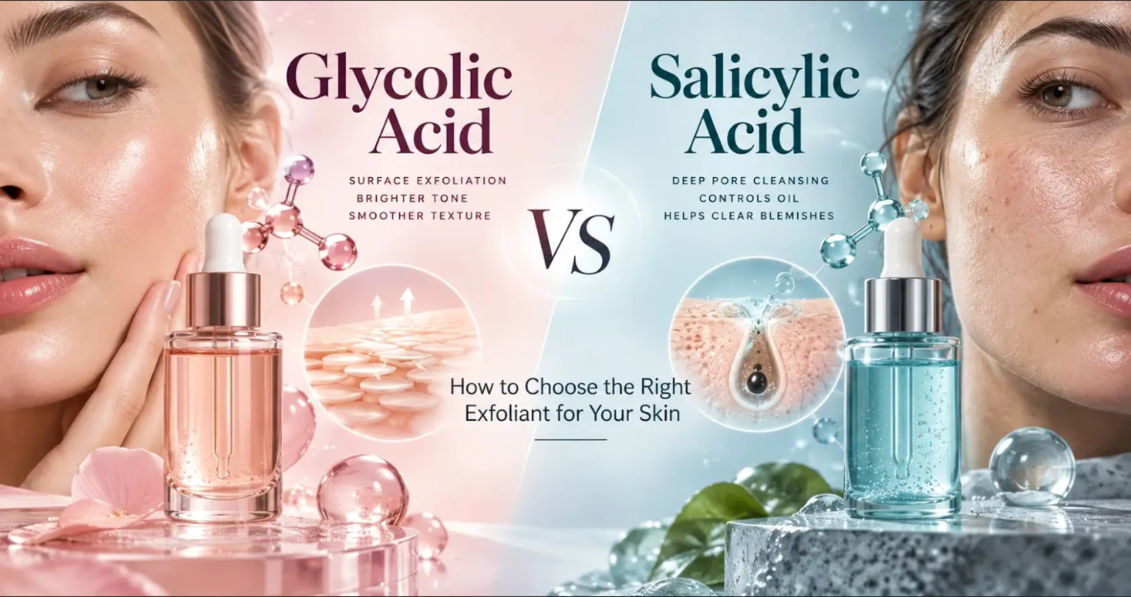
Walk into any skincare shop and you will see two acids everywhere: glycolic acid and salicylic acid. Both promise smoother, clearer skin. So which one should you actually buy?
The answer depends on your skin type and what you want to fix. Glycolic acid works best on dullness, rough texture and old marks, and a glycolic acid toner is the easiest way to try it. Salicylic acid is better for oily skin, blackheads and breakouts.
This guide explains the difference in plain words, so you can pick the right one the first time. Whatever you choose, look for skin care products that print the acid and its strength on the label, so you know exactly what you are using.
The main difference in one minute
Both acids remove dead skin cells. They just work in different places.
• Glycolic acid (an AHA) works on the surface of your skin. It dissolves in water and loosens the dead cells sitting on top.
• Salicylic acid (a BHA) dissolves in oil. That lets it go inside your pores and clear out the oil and dead cells stuck there.
Think of it like cleaning a floor. Glycolic acid polishes the surface. Salicylic acid cleans out the gaps between the tiles.
Side-by-side comparison
| Glycolic acid (AHA) | Salicylic acid (BHA) | |
| Works on | Skin surface | Inside pores |
| Best for | Dullness, rough texture, old marks | Oily skin, blackheads, breakouts |
| Skin types | Normal, dry, combination | Oily, acne-prone, combination |
| Usual product | Leave-on toner or serum | Face wash or leave-on treatment |
| Common strength | 5% to 10% | 0.5% to 2% |
| Sun sensitivity | Yes, wear sunscreen daily | Lower, but sunscreen is still a must |
Choose glycolic acid if…
• your skin looks dull or tired
• your cheeks or forehead feel rough
• you have old acne marks or uneven tone
• your skin is normal to dry
Choose salicylic acid if…
• your face gets oily by midday
• you get blackheads on your nose or chin
• you have regular breakouts
• your pores look large and clogged
Can you use both?
Yes, many people with combination skin do. The safe way is to not use them at the same time when you are starting out.
A simple routine looks like this:
• Morning: a salicylic acid face wash, then moisturizer and sunscreen.
• Evening, 2 to 3 nights a week: a glycolic acid toner after washing, then moisturizer.
• Other evenings: just a gentle wash and moisturizer.
If your skin feels tight, stings or turns red, cut back to one acid until it calms down.
Mistakes that cause irritation
• Using a strong acid every day from the first week
• Mixing acids with a face scrub on the same day
• Skipping moisturizer after an acid
• Forgetting sunscreen the next morning
• Using acids on skin that was just threaded, waxed or shaved
FAQs
- Which acid is better for acne marks?
Glycolic acid. It helps old marks fade by speeding up how fast surface skin renews. - Which is better for blackheads?
Salicylic acid, because it can get inside oily pores. - Are these acids safe for sensitive skin?
Start with a low strength, use it two nights a week, and do a patch test first. If you have eczema or rosacea, ask a dermatologist before using any acid. - How long until I see results?
Usually three to four weeks for smoother skin. Marks and blackheads take longer, often six to eight weeks.
The best acid is the one that matches your skin. Start slowly, use one at a time, and always protect your skin from the sun.