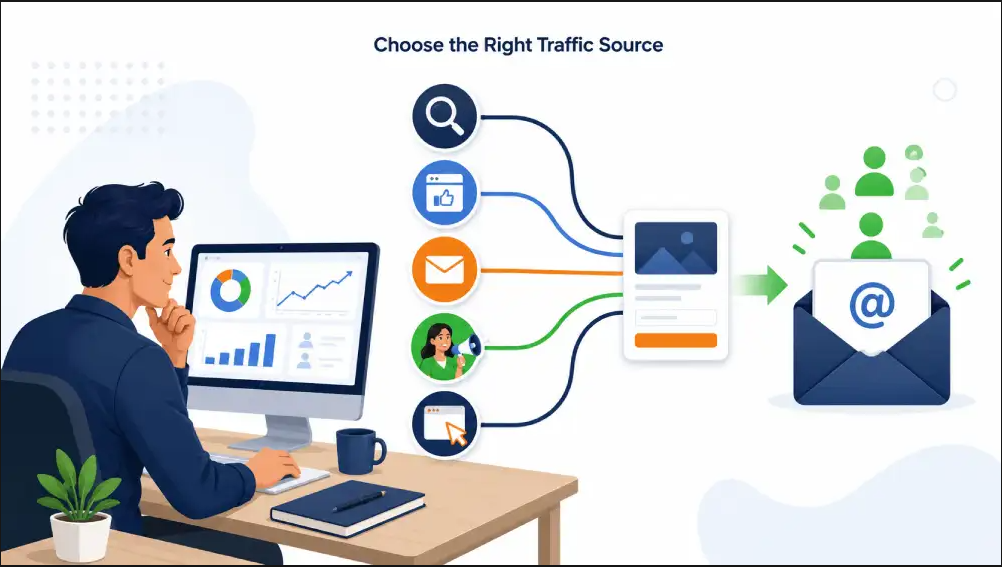
Building an email list gives a business something that social-media reach alone cannot: a direct way to communicate with potential customers. But before choosing a traffic source, marketers need to ask an important question: What kind of visitor does my offer actually need?
There is no single “best” traffic source for every business. A course creator may need leads for a webinar. An affiliate marketer may need opt-ins for a presell page. An e-commerce brand may need shoppers for a seasonal product launch. The right choice depends on the audience, offer, budget, and how well the landing page converts.
This guide explains the most common traffic sources and how to choose one without wasting your first campaign budget.
Start With the Goal, Not the Traffic Source
Many businesses start by asking, “Where can I buy traffic?” A better question is: “What action do I want a visitor to take?”
Your goal may be to:
- Collect email subscribers through a lead magnet
- Generate webinar registrations
- Test a new digital product or affiliate offer
- Drive product-page visits for an e-commerce store
- Build brand awareness over time
- Generate booked calls or qualified leads
For example, a visitor who clicks an ad but never joins your list may still be useful for brand awareness. But if your goal is email-list growth, the main metric is not just clicks. It is the number of relevant people who opt in and later engage with your emails.
This is why tracking matters. Google Analytics allows marketers to use UTM parameters such as source, medium, and campaign name to identify where campaign visitors came from. Review Google’s campaign URL guidance before launching a paid campaign.
1. Search Engine Optimization: Best for Long-Term Intent
SEO brings visitors from search engines when people are actively looking for an answer, product, or service. It is useful for businesses that can publish helpful articles, product pages, guides, and comparison content consistently.
For example, a software company can target searches such as “best project management tool for small teams.” A digital-product creator can publish a guide that solves a specific problem, then offer a relevant checklist or free training in exchange for an email address.
Best for
- Businesses with patience for long-term growth
- Educational content and evergreen topics
- High-intent searches
- Building authority and trust
Main limitation
SEO often takes time. It is rarely the fastest way to test whether a new offer or landing page converts.
Businesses should treat SEO as a long-term asset, not as their only traffic plan. Strong teams align content, tracking, and business goals—a principle also relevant to effective leadership and strategic alignment.
2. Social Media Ads: Best for Targeting and Fast Testing
Platforms such as Facebook, Instagram, TikTok, and LinkedIn can help businesses reach audiences based on interests, demographics, behavior, and professional characteristics.
Social ads are especially useful when a brand has an eye-catching product, a clear offer, and enough budget to test different creative ideas. A physical-product brand may use video ads to demonstrate how a product works. A coach may promote a free webinar or downloadable guide.
Best for
- Visual products and lifestyle brands
- Retargeting website visitors
- Fast creative testing
- Building awareness before a launch
Main limitation
Social ads can become expensive when targeting is too broad or when the landing page is weak. A great ad cannot fix an unclear offer.
Before scaling, test one audience, one offer, and one simple landing page. Measure cost per lead, not only cost per click.
3. Solo Ads: Best for Email List Building and Digital Offers
Solo ads are email-based promotions. A seller sends an offer to a segment of their email audience, directing interested subscribers to the buyer’s landing page.
They can be a practical option for affiliate marketers, course creators, newsletter builders, webinar hosts, and digital-product sellers who want to test an opt-in funnel. This works best when the offer is relevant to the receiving audience and the landing page has one clear action.
For example, an affiliate marketer promoting a business-opportunity product may first send visitors to a free training, checklist, or email course rather than directly to an affiliate link. This gives the marketer a chance to build trust before presenting a paid offer.
Marketers considering this approach should learn how solo ads for affiliate marketing work, including traffic quality, niche relevance, click tracking, and funnel preparation.
Best for
- Affiliate offers
- Digital products and online courses
- Webinar registration pages
- Lead magnets and email-list growth
- Testing a new opt-in funnel
Main limitation
Solo ads are not a shortcut to guaranteed sales. Results depend on the seller’s audience quality, offer-market fit, landing-page conversion rate, follow-up emails, and proper tracking.
A responsible solo-ad campaign should focus on real traffic delivery and transparent reporting—not unrealistic income promises.
4. Influencer Partnerships: Best for Trust and Product Discovery
Influencer marketing works well when buyers need to see a product in use or hear about it from a trusted creator. This is often a strong option for physical products, beauty items, fitness products, fashion, home goods, and consumer apps.
A smaller creator with a focused audience can sometimes produce better results than a large creator with a broad, less engaged following.
Best for
- Physical products
- Niche consumer brands
- Visual demonstrations and reviews
- Brand awareness and credibility
Main limitation
Influencer content is not automatically a conversion campaign. The audience may enjoy the content without taking action.
If an influencer is paid or receives something of value, the relationship should be disclosed clearly. The Federal Trade Commission’s endorsement guidance explains why transparent endorsements matter.
5. Paid Search: Best for High-Intent Buyers
Paid search ads place a business in front of people who are already searching for a solution. This can be powerful for services, software, local businesses, and products with clear buying intent.
For instance, someone searching “buy email marketing software” is likely closer to deciding than someone casually scrolling through social media.
Best for
- Services with clear demand
- Software and tools
- Local businesses
- Product searches with buyer intent
- Lead-generation campaigns
Main limitation
Popular keywords can be costly. Beginners should avoid sending paid-search traffic to a generic homepage. Instead, send visitors to a focused page that matches the search query and includes one clear next step.
A Simple Traffic-Source
Decision Framework
Use this quick framework before spending money:
| Your main goal | Suitable traffic source |
| Long-term organic leads | SEO |
| Fast audience and creative testing | Social media ads |
| Email opt-ins for affiliate or digital offers | Solo ads |
| Product awareness and social proof | Influencer partnerships |
| Leads from people actively searching | Paid search |
The right traffic source should match the buyer’s stage.
A cold audience may need a helpful guide, video, or lead magnet first. A warmer audience may be ready for a webinar, consultation, product page, or special offer.
Do Not Skip Funnel Preparation
Traffic cannot solve a weak funnel. Before buying visitors, review these basics:
- Clear headline: Can visitors understand the offer in five seconds?
- Relevant landing page: Does the page match the traffic source and message?
- One primary action: Is the visitor asked to opt in, buy, register, or book—not all four?
- Mobile experience: Does the page load and display properly on phones?
- Follow-up emails: Is there a useful email sequence after someone subscribes?
- Tracking: Can you identify clicks, opt-ins, sales, and refunds by campaign?
Automation can help manage follow-up messages and reporting, but it should support a clear strategy rather than replace one. Businesses can learn more about the wider role of systems and efficiency in automation and modern work.
Test Small Before You Scale
A small campaign is not a failure if it does not produce immediate sales. It can reveal useful information:
- Does the audience click?
- Do visitors opt in?
- Which headline performs better?
- Does the lead magnet attract the right people?
- Are subscribers opening follow-up emails?
- Is the offer relevant to the audience?
Start with a budget you can afford to learn from. Improve one variable at a time, such as the headline, landing page, lead magnet, or audience source. Scaling too early can magnify an untested problem.
Final Thoughts
The best traffic source is not necessarily the cheapest source or the one with the biggest number of clicks. It is the source that brings the right visitors to a well-matched offer and gives you enough data to improve your funnel.
SEO can build long-term trust. Social ads can help test creative ideas. Influencer partnerships can build product awareness. Paid search can reach people with strong intent. And for marketers building an email list around affiliate offers, webinars, and digital products, solo ads can be a focused way to test a funnel when used with transparency and tracking.
Choose one channel, set a clear goal, track the results, and improve before spending more.
What is the best traffic source for building an email list?
The best traffic source depends on your offer and audience. SEO is useful for long-term organic growth, social ads help test audiences quickly, paid search reaches people with active intent, and solo ads can work well for email opt-ins around digital products, webinars, and affiliate funnels.
Are solo ads good for growing an email list?
Solo ads can be useful for growing an email list when the seller’s audience is relevant to your offer and your landing page has a clear lead magnet. Track clicks, opt-ins, email engagement, and sales so you can judge traffic quality rather than relying only on the number of clicks delivered.
Should I use SEO or paid ads to grow my email list?
SEO is usually better for long-term growth because it can bring ongoing visitors without paying for every click. Paid ads are better when you need faster testing, immediate visibility, or quick data about a new offer. Many businesses use both: paid traffic for testing and SEO for sustainable growth.
How much should I spend on my first traffic campaign?
Start with a small budget you can afford to learn from. The purpose of a first campaign is to test whether people click, opt in, and engage with your follow-up emails. Avoid scaling until you know your landing page, offer, and traffic source are working together.
What should I track in an email-list growth campaign?
Track traffic source, clicks, landing-page conversion rate, cost per lead, email open rate, click rate, sales, refunds, and unsubscribe rate. Use UTM parameters so you can see which campaign and traffic source produced each result.
Why do visitors click but not join my email list?
This often happens when there is a mismatch between the ad or promotion and the landing page. Your offer may be unclear, the lead magnet may not feel valuable enough, the page may load slowly on mobile, or visitors may not trust the page. Keep one clear message and one main action.
Do I need a lead magnet to collect email subscribers?
A lead magnet is not always required, but it usually gives people a stronger reason to subscribe. Useful examples include a checklist, discount, template, free training, product guide, email course, or webinar. The lead magnet should solve a small but relevant problem for your ideal customer.