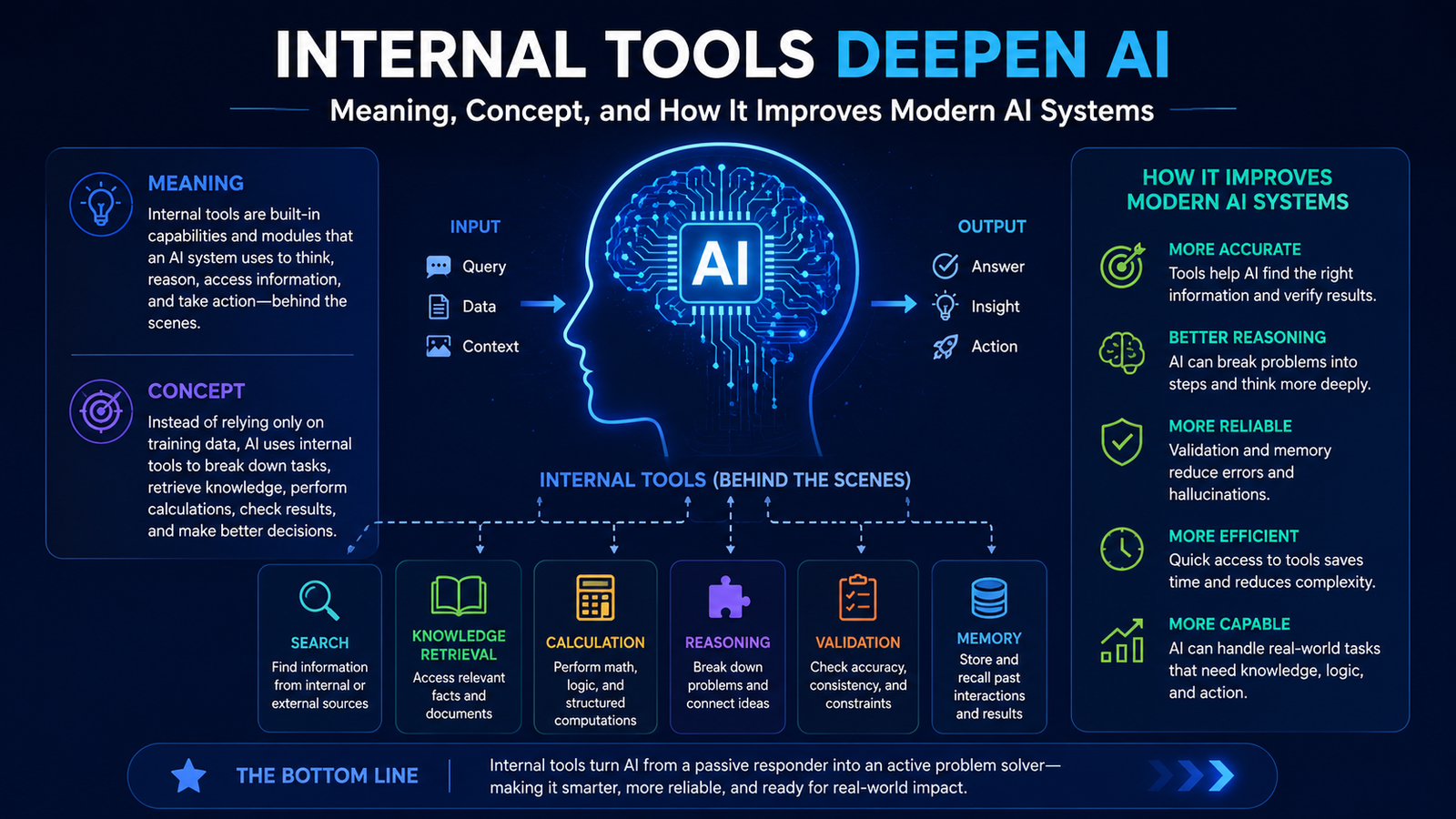
The phrase “internal tools deepen AI” refers to the idea that artificial intelligence becomes more powerful when it is connected with internal systems, tools, and structured workflows. Instead of relying only on basic model responses, modern AI can interact with databases, APIs, plugins, automation systems, and enterprise tools to produce more accurate and useful results. This integration helps AI move beyond simple text generation into real problem-solving. In this article, we will explore what internal tools mean in AI, how they deepen AI capabilities, and why they are important for building smarter, more efficient AI-powered systems in 2026 and beyond.
What Does “Internal Tools Deepen AI” Mean?
Simple Explanation
“Internal tools deepen AI” means:
- AI becomes smarter when connected to external or internal systems
- It can access real data instead of only trained knowledge
- It can perform actions, not just generate text
Internal tools act like extensions of AI’s brain.
Example of Internal Tools in AI
AI becomes more powerful when it connects to tools like:
- Databases (customer data, records, analytics)
- APIs (weather, finance, search systems)
- CRM systems (sales and marketing tools)
- Automation workflows (emails, tasks, scheduling)
How Internal Tools Deepen AI Capability
1. Real-Time Data Access
Without tools, AI relies on training data. With internal tools, it can:
- Fetch live data
- Access updated records
- Provide real-time answers
This makes responses more accurate and relevant.
2. Task Execution Ability
Internal tools allow AI to:
- Send emails
- Generate reports
- Update CRM systems
- Trigger workflows
This shifts AI from “assistant” to “operator.”
3. Improved Decision Making
AI becomes more intelligent because it can:
- Analyze internal business data
- Compare historical trends
- Suggest optimized actions
This improves business decision quality.
4. Personalization at Scale
With internal tools, AI can:
- Access user profiles
- Understand preferences
- Deliver personalized responses
This is widely used in marketing and e-commerce.
Types of Internal Tools Used in AI Systems
1. Data Tools
These include:
- SQL databases
- Data warehouses
- Analytics dashboards
They help AI retrieve structured information.
2. API Integrations
APIs allow AI to connect with:
- Payment systems
- Weather services
- Social media platforms
- Search engines
3. Automation Tools
These tools help AI perform actions:
- Zapier
- Make (Integromat)
- Custom workflow engines
4. Enterprise Tools
Used in business environments:
- CRM systems like Salesforce
- ERP systems
- Customer support platforms
Why Internal Tools Are Important for AI Growth
More Accuracy
AI becomes more reliable because it uses real data instead of guesses.
Better Efficiency
Tasks that take humans hours can be completed in seconds.
Business Integration
Companies can directly connect AI to:
- Sales systems
- Marketing platforms
- Customer service tools
Scalability
AI can handle large operations without increasing workload.
Real-World Use Cases
E-Commerce
AI connected to internal tools can:
- Track orders
- Suggest products
- Update inventory
Customer Support
AI can:
- Read customer history
- Respond with personalized solutions
- Escalate issues automatically
Marketing Automation
AI can:
- Run email campaigns
- Analyze engagement
- Optimize ads
Finance Systems
AI can:
- Generate reports
- Detect anomalies
- Forecast trends
Benefits of Internal Tool Integration in AI
Smarter Responses
AI gives more accurate and context-aware answers.
Automation Power
Reduces manual work significantly.
Faster Business Operations
Speeds up workflows across departments.
Improved User Experience
Users get faster and more personalized results.
Challenges of Internal Tool Integration
Data Security Risks
Connecting tools increases exposure to sensitive data.
System Complexity
More integrations require technical setup and maintenance.
Cost of Implementation
Advanced systems may require infrastructure investment.
Dependency on Data Quality
Poor data leads to poor AI output.
Future of AI with Internal Tools
In the future, AI will:
- Fully operate business systems
- Replace manual dashboards
- Act as real-time decision engines
- Connect across multiple platforms simultaneously
AI will not just respond—it will act independently using internal tools.
Final Thoughts
The concept of “internal tools deepen AI” highlights how artificial intelligence becomes significantly more powerful when connected to real systems and workflows. Instead of being limited to text generation, AI evolves into a dynamic system capable of accessing data, executing tasks, and improving decision-making. This transformation is essential for businesses and developers building modern AI solutions. As internal tool integration increases, AI will continue to move closer to full automation, smarter operations, and real-world problem-solving at scale.
FAQs
1. What does internal tools deepen AI mean?
It means AI becomes more powerful when connected to internal systems, APIs, and databases.
2. Why are internal tools important for AI?
They allow AI to access real-time data and perform actions instead of just generating text.
3. What are examples of internal AI tools?
Databases, APIs, CRM systems, and automation platforms.
4. How do internal tools improve AI accuracy?
They provide real-time and structured data instead of relying only on training knowledge.
5. Will AI depend more on internal tools in the future?
Yes, future AI systems will rely heavily on tool integration for automation and decision-making.