If you’ve come across the Spanish phrase “encuentra el ritmo” and are wondering what it means, you’re not alone. This expression appears frequently in music, motivational content, fitness programs, advertising campaigns, and everyday Spanish conversations.
At its core, “encuentra el ritmo” means “find the rhythm” in English. However, like many Spanish expressions, its meaning often extends beyond the literal translation. Depending on the context, it can refer to finding a musical beat, getting comfortable with a task, adapting to a new lifestyle, or discovering your personal flow in life.
In this comprehensive guide, you’ll learn the exact meaning of “encuentra el ritmo,” its pronunciation, grammar, cultural significance, common examples, and how native speakers use it in real-world situations.
What Does “Encuentra el Ritmo” Mean?
The Spanish phrase “encuentra el ritmo” translates directly to:
“Find the rhythm.”
Word-by-Word Translation
| Spanish | English |
| Encuentra | Find |
| El | The |
| Ritmo | Rhythm |
Together, the phrase literally means:
“Find the rhythm.”
However, native Spanish speakers often use it figuratively to encourage someone to find their pace, flow, or comfort level in a particular situation.
Featured Snippet Answer
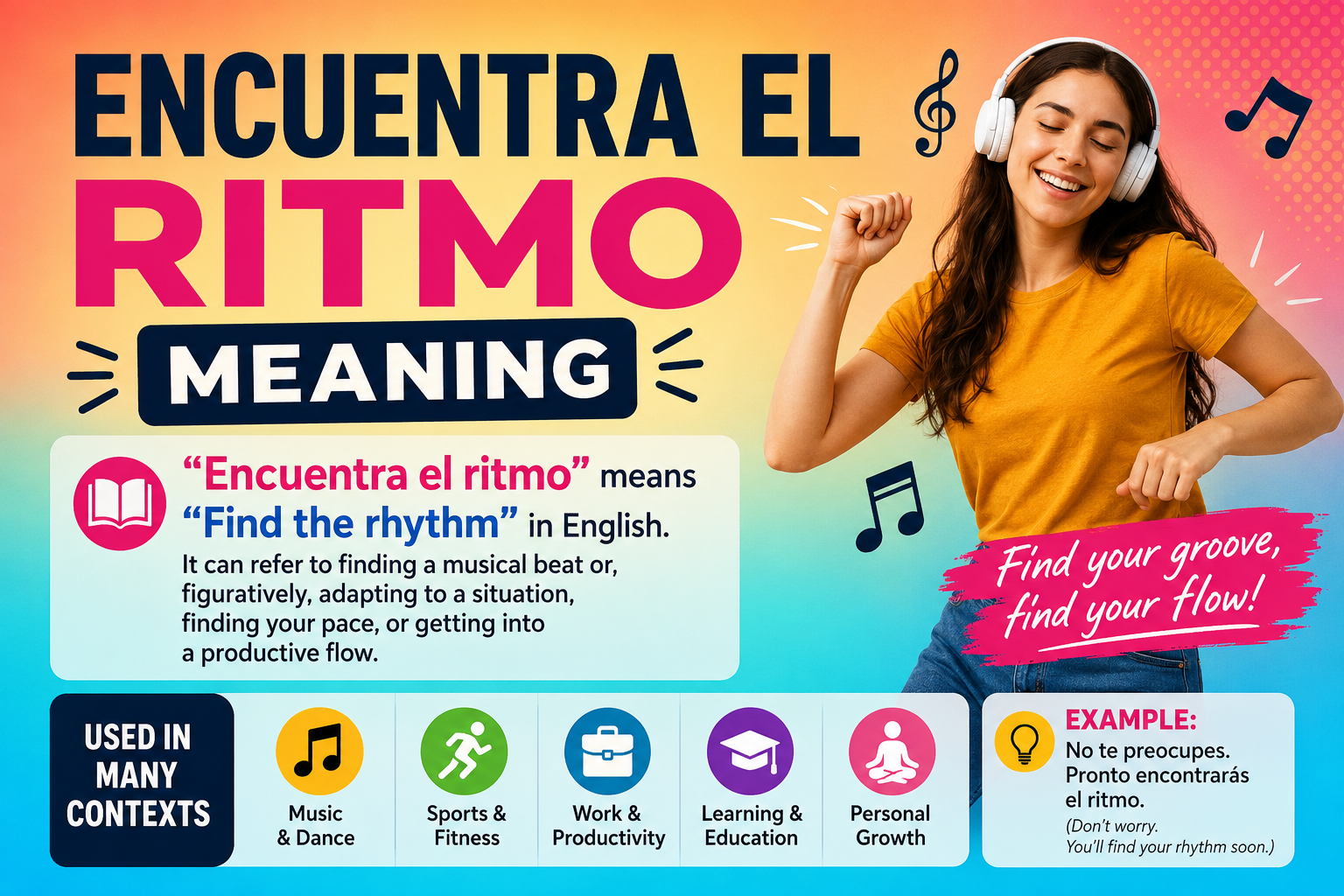
“Encuentra el ritmo” means “find the rhythm” in English. It can refer to finding a musical beat or, figuratively, adapting to a situation, finding your pace, or getting into a productive flow.
Understanding the Grammar of “Encuentra el Ritmo”
To fully understand the phrase, let’s break down its grammatical structure.
Encuentra
The word “encuentra” comes from the Spanish verb:
Encontrar = To find
In this phrase, “encuentra” is the:
- Informal command form (tú command)
- Used when giving advice, instructions, or encouragement
Examples:
- Encuentra tu camino. → Find your path.
- Encuentra la respuesta. → Find the answer.
- Encuentra el ritmo. → Find the rhythm.
The phrase often carries a positive and motivational tone.
El Ritmo
“Ritmo” means:
- Rhythm
- Beat
- Pace
- Flow
Depending on context, “ritmo” can refer to:
- Music
- Dance
- Work pace
- Exercise intensity
- Lifestyle patterns
- Personal productivity
Literal Meaning of Encuentra el Ritmo
In its most literal sense, the phrase relates to music and dance.
Examples include:
Music Lessons
A teacher might say:
Encuentra el ritmo antes de tocar la canción.
Translation:
Find the rhythm before playing the song.
Dance Classes
An instructor may encourage students:
Encuentra el ritmo y sigue los movimientos.
Translation:
Find the rhythm and follow the movements.
In these cases, the phrase refers directly to timing, beat, and musical synchronization.
Figurative Meaning of Encuentra el Ritmo
The phrase becomes even more interesting when used metaphorically.
Many Spanish speakers use it to mean:
- Find your groove
- Find your flow
- Get into a rhythm
- Adapt comfortably
- Settle into a routine
This figurative use is extremely common.
Example: Starting a New Job
Someone might say:
No te preocupes. Pronto encontrarás el ritmo.
Translation:
Don’t worry. You’ll find your rhythm soon.
The meaning isn’t about music at all.
Instead, it means:
You’ll become comfortable and adapt to the new environment.
Example: Learning a Skill
Al principio fue difícil, pero encontré el ritmo.
Translation:
At first it was difficult, but I found my rhythm.
This suggests:
- Increased confidence
- Improved performance
- Natural progress
Common English Translations
While “find the rhythm” is the direct translation, several English equivalents may fit depending on context.
Possible Translations
Find the Rhythm
Most literal translation.
Example:
Encuentra el ritmo de la música.
Find the rhythm of the music.
Find Your Groove
Common informal translation.
Example:
Finalmente encontré el ritmo.
I finally found my groove.
Get Into the Swing of Things
Natural English equivalent.
Example:
Encontrarás el ritmo pronto.
You’ll get into the swing of things soon.
Find Your Pace
Often used in work or fitness settings.
Example:
Encuentra el ritmo adecuado para ti.
Find the pace that works for you.
Find Your Flow
Popular in productivity and wellness contexts.
Example:
Encuentra el ritmo de tu día.
Find your flow throughout the day.
Pronunciation Guide
The pronunciation of “encuentra el ritmo” is:
en-KWEN-trah el REET-mo
Phonetic breakdown:
- En = en
- Cuen = kwen
- Tra = trah
- El = el
- Rit = reet
- Mo = moh
Approximate pronunciation:
en-KWEN-trah el REET-moh
For English speakers, the “r” sound in Spanish is softer than many expect and should be lightly rolled or tapped.
When Native Spanish Speakers Use “Encuentra el Ritmo”
This phrase appears in many real-life situations.
1. Music and Dance
The most obvious use.
Examples:
- Dance rehearsals
- Music lessons
- Band practice
- Performance coaching
Example:
Encuentra el ritmo de la batería.
Translation:
Find the rhythm of the drums.
2. Sports and Fitness
Fitness trainers frequently use the phrase.
Examples:
- Running programs
- Cycling classes
- Workout sessions
- Athletic training
Example:
Encuentra el ritmo que puedas mantener.
Translation:
Find a pace you can maintain.
3. Productivity and Work
Many motivational speakers use the phrase metaphorically.
Example:
Una vez que encuentres el ritmo, trabajarás más rápido.
Translation:
Once you find your rhythm, you’ll work faster.
4. Personal Development
Self-improvement content often emphasizes finding balance and consistency.
Example:
Encuentra el ritmo de vida que te haga feliz.
Translation:
Find the lifestyle rhythm that makes you happy.
5. Education and Learning
Teachers may use the phrase to encourage students.
Example:
Sigue practicando hasta encontrar el ritmo.
Translation:
Keep practicing until you find your rhythm.
Cultural Significance of Rhythm in Spanish-Speaking Countries
The concept of rhythm holds special importance across many Spanish-speaking cultures.
Music genres such as:
- Salsa
- Bachata
- Merengue
- Flamenco
- Cumbia
- Reggaetón
place strong emphasis on rhythm and timing.
As a result, “ritmo” often symbolizes more than music.
It can represent:
- Harmony
- Progress
- Adaptation
- Confidence
- Personal expression
Because of this cultural connection, “encuentra el ritmo” often carries an encouraging and uplifting message.
It suggests that success comes when someone discovers a natural, sustainable pace.
Examples of Encuentra el Ritmo in Sentences
Here are practical examples with translations.
Example 1
Spanish:
Encuentra el ritmo de la canción.
English:
Find the rhythm of the song.
Example 2
Spanish:
Tardé algunas semanas en encontrar el ritmo.
English:
It took me a few weeks to find my rhythm.
Example 3
Spanish:
Encuentra el ritmo adecuado para correr.
English:
Find the right pace for running.
Example 4
Spanish:
Poco a poco encontrarás el ritmo.
English:
Little by little, you’ll find your rhythm.
Example 5
Spanish:
Cuando encuentres el ritmo, todo será más fácil.
English:
When you find your rhythm, everything will become easier.
Similar Spanish Expressions
Several Spanish phrases convey a similar idea.
Tomarle el Ritmo
Meaning:
To get used to something.
Example:
Ya le tomé el ritmo al trabajo.
Translation:
I’ve gotten used to the job.
Agarrar el Ritmo
Meaning:
To catch the rhythm.
Example:
Después de unos días agarré el ritmo.
Translation:
After a few days, I got into the rhythm.
Adaptarse
Meaning:
To adapt.
Example:
Me adapté rápidamente.
Translation:
I adapted quickly.
Seguir el Ritmo
Meaning:
To keep up with the rhythm.
Example:
No puedo seguir el ritmo.
Translation:
I can’t keep up.
Why the Phrase Is Popular in Marketing and Motivation
Many brands use “encuentra el ritmo” because it resonates emotionally.
It communicates:
- Progress
- Personal growth
- Confidence
- Consistency
- Momentum
You’ll often see it in:
- Fitness campaigns
- Music promotions
- Wellness programs
- Productivity apps
- Educational materials
The phrase inspires action while remaining simple and memorable.
Common Mistakes When Translating Encuentra el Ritmo
Translating It Too Literally
Not every use refers to music.
For example:
Encontró el ritmo en su nuevo trabajo.
Better translation:
She found her groove in her new job.
Not:
She found the rhythm in her new job.
Ignoring Context
The correct English translation depends heavily on the situation.
Possible translations include:
- Find your rhythm
- Find your groove
- Find your flow
- Find your pace
- Get comfortable
- Settle into a routine
Always consider the broader meaning.
Conclusion
The meaning of “encuentra el ritmo” goes far beyond its literal translation of “find the rhythm.” While it certainly applies to music and dance, native Spanish speakers often use it as a powerful metaphor for finding balance, confidence, momentum, and comfort in various areas of life.
Whether someone is starting a new job, learning a skill, training for a race, or adjusting to a new routine, “encuentra el ritmo” conveys an encouraging message: keep going until things begin to flow naturally.
Understanding both the literal and figurative meanings of this phrase allows you to interpret it accurately in conversations, songs, advertising, and everyday Spanish communication. In many situations, the best translation may not be “find the rhythm” at all—it may be “find your groove,” “find your flow,” or simply “settle into your pace.”
Ultimately, “encuentra el ritmo” is a reminder that progress often begins when you discover the rhythm that works best for you.
FAQ About Encuentra el Ritmo Meaning
What does “encuentra el ritmo” mean in English?
“Encuentra el ritmo” literally means “find the rhythm.” It can also mean finding your pace, flow, groove, or comfort level in a situation.
Is “encuentra el ritmo” a common Spanish phrase?
Yes. Native speakers use it in music, sports, education, work, and motivational contexts.
Does the phrase always refer to music?
No. While it can refer to musical rhythm, it is frequently used figuratively to describe adaptation, progress, and finding a comfortable routine.
How do you pronounce “encuentra el ritmo”?
It is pronounced approximately as:
en-KWEN-trah el REET-moh
What is the figurative meaning of “encuentra el ritmo”?
Figuratively, it means:
- Find your groove
- Find your flow
- Settle into a routine
- Adapt successfully
- Discover a sustainable pace
Is it positive or negative?
The phrase is almost always positive. It is commonly used to encourage someone who is learning, adapting, or working toward improvement.